
Q&A with Kristin Jaffe: 50 Years at Shipley
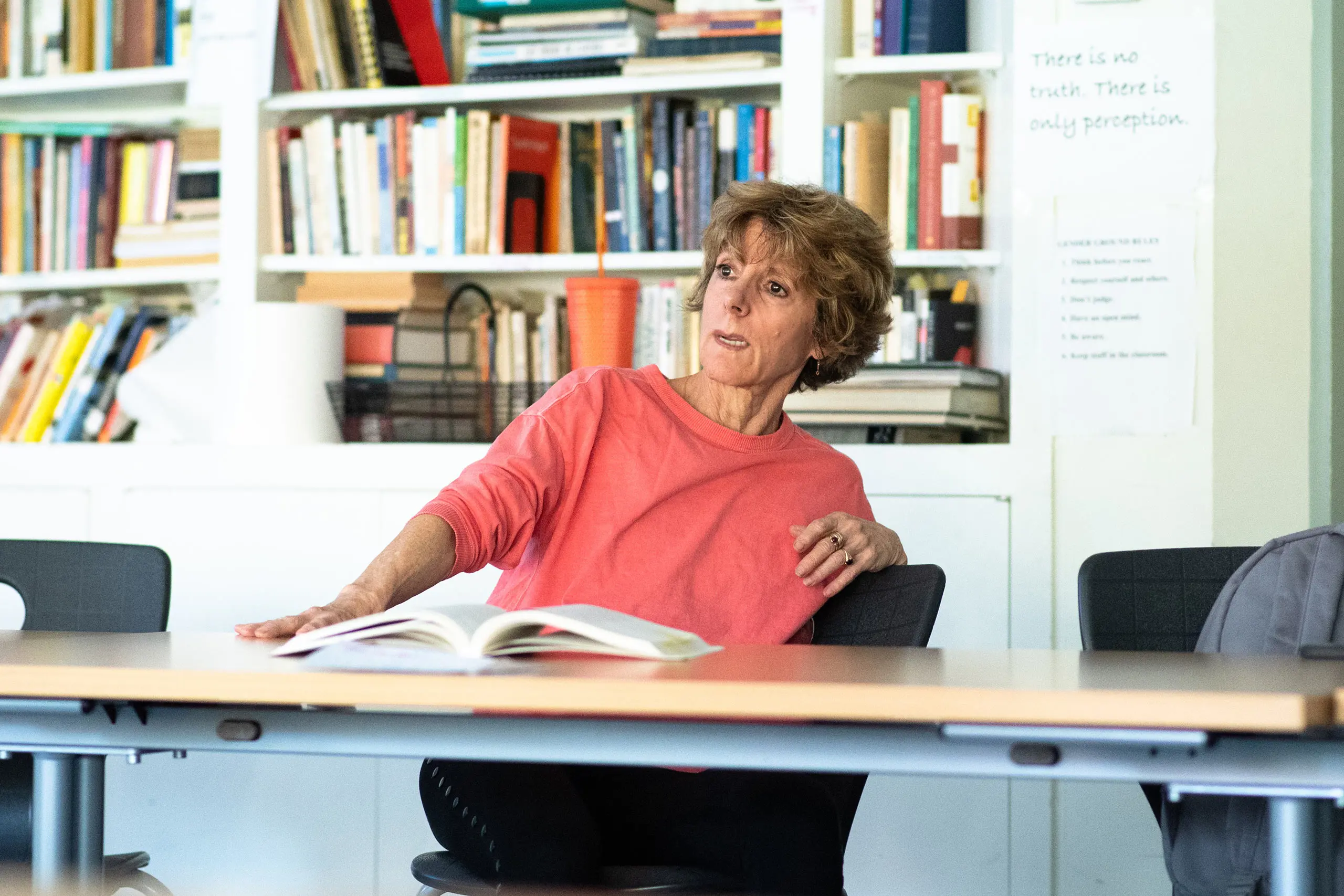
Kristin Jaffe never planned to be a teacher. A self-described problem student and reluctant reader, she walked across the street to Shipley as a Bryn Mawr College senior in 1977 because she needed a job. She’s been here ever since.
After 50 years, she has taught nearly every grade from fourth through twelfth and now teaches ninth-grade English. Throughout that time, she has taught electives on gender and literature, introduced students to Victorian novels, and held firm on the importance of grammar. In this Q&A, she looks back on what has changed at Shipley, what hasn’t, and what it means to be a teacher.
| You never planned on becoming a teacher. What happened? |
That’s completely true. My mother was a lifelong teacher, and there was a lot of teaching in my family. But I was a bit of a problem in school, mainly discipline. I had two supersonic older sisters, so I was the misfit, and the non-reader in a family that read all the time. I acted out a lot. I cleaned up my act in eighth grade. The turning point was that my mother was going to be my Latin teacher. I thought, “I may be a bad student, but I’m going to be an A student in this class, because she’s not going to have that over me.” I was late getting there, but that turned things around. |
| Did your experience as a student shape you as a teacher? |
Absolutely. I always found myself in places where everybody seemed very smart and I had to measure up. I went to boarding school, following one of my sisters, and everybody said, “That’s going to be tough for her, because she’s not her sister.” I felt I had a lot to prove. I was just talking to a student who was worried about a question she’d missed on a quiz. I told her, “I get it. I’m the same way. I’m very anxious, and I feel deeply that I’m always going to mess something up.” That’s what drives me. |
| Tell me about walking across the street from Bryn Mawr to interview at Shipley. |
I was at Bryn Mawr, surrounded by earnest, high-achieving types headed to law school, and I thought, “I don’t know what I’m good at.” I knew what I liked, but I thought, “I’ve just got to get a job.” I knew Shipley was across the street, so I literally walked across it. I interviewed with [then Head of School] Nancy Lauber at nine in the morning, early by college standards, and she offered me a Newport cigarette, which is highly menthol and very strong. I wasn’t a smoker, but of course I took it. I’d never been to a job interview in my life, and there I was puffing on this thing, thinking, “This is kind of crazy.” They hired me to teach fourth and sixth grade, and I loved it. That fall, at parents’ night, I told the parents it’s really good for kids to fail. I had no concept of my audience. Up goes a hand: “So you think my child should fail?” I quickly realized I had stepped in it. I do think a little failure is healthy, but that is not the forum in which you say it. And just recently, at parents’ night, a student told me, “My mom says you were really honest.” I’d handed something out and said, “You don’t have to read this. I don’t expect you to.” That was true! So, foot in mouth again. Maybe the message is that you live and you don’t learn. |
| You arrived when Shipley was freshly coed, boarding was being phased out, and uniforms were still around. What has changed at Shipley during your time here? |
A lot. When I came to the Upper School in 1980, it was structured by departments, and the departments had a huge amount of power. It was much more hierarchical than it is now. At my first department meeting, I put my hand up and said, “Can I say something?” One of my colleagues, who later became a good friend, essentially said, “No. Of course you can’t. Who are you? Know your place.” There was no mentoring. I was told, “Pick up some Italian. You need to be able to teach Petrarch in Italian.” That was also the first year female teachers were allowed to wear pants, and students were expected to stand when the teacher walked in. Students had a much more formal relationship with their teachers, and that’s not something I particularly want or value. Today they’re more familiar, more relaxed, more willing to challenge. A lot of that is really good. It’s not a net positive or negative, just different. |
| You’ve taught some groundbreaking electives. Talk about your work on gender and literature. |
When I came to the Upper School, the department head was Pucky Thomas, an incredibly dynamic, very intimidating person who hailed from Berkeley and had a doctorate. We co-taught a couple of times in Brownell, with about thirty kids. She was clearly the lead, and I was learning on the fly. That’s where I got interested in gender and literature, and after she left I kept teaching it in different guises. It was absolutely the most fun in the world for me. It always had special meaning, partly because I often felt not everybody believed in it. But I thought it was a game changer for some kids. We looked at advertising and gender, at how women are portrayed. Making kids aware of the culture at large is really interesting. |
| What’s your approach to teaching a book, and what do you love to read? |
My thing is: tap into what hooks you and pursue that. I never say, “Let’s all write about red imagery in The Scarlet Letter.” Instead, I might ask, “What is it about the book that intrigues you? Hawthorne’s use of Romanticism and nature? A feminist perspective?” Find your way in. I also tend to be interdisciplinary. If I teach Gatsby, we’ll talk about much more than Gatsby: the context, Fitzgerald, all the good gossip. It can have a bit of a People magazine feel, but if it works, it works. As for favorites, I’m not a favorite-book person any more than I’m a favorite-food person. If I had to pick a domain, it’s the nineteenth-century novel. I’m very driven by character, which is why I love memoir. At bottom, I love people’s stories. |
| Alumni often say they left Shipley well prepared as writers. How do you teach writing? |
Reading and writing are integral to one another. You learn to write through reading, and I try to get kids to see that. I’m also fascinated by language. When I started Latin with my mother, I discovered that I love analysis and logic, even though I always insisted I hated math. So I try to break down writing for kids, and it’s different for everyone. I’m also, much to the chagrin of many people, a huge believer in grammar and usage, in understanding how language works. And there’s getting an ear for language, hearing what your prose sounds like. There’s no one method. It’s a lot of different skills, which is why it’s language arts, really, not English. That fascination with language shows up in small moments. I was talking to a senior about Chaucer, and we were going through old books in the library and found a facsimile Kelmscott Chaucer. He asked, “What are these words?” I said, “It’s such a cool language to learn, Middle English, and to see how English has changed.” |
| How would your students describe you? |
A lot of times kids use the word “funny,” though I’m not striving to be. I’d be more comfortable if you asked them. What I love about teaching is that I feel so comfortable with kids in a way I don’t with adults. I enjoy their spontaneity, and I like all ages, just in different ways. I’ve taught pretty much fourth through twelfth grade. Now I’m teaching all ninth grade, and I really enjoy ninth graders. They’re affectionate, and they’re learning about cynicism, but they’re not cynical, unlike older kids, who are more hard-boiled. |
| What has kept you at Shipley for 50 years? |
Dare I say, inertia? My kids all went here, with varying degrees of it being a good match. But it’s always different. No two classes are ever the same. Some classes, I think, “I don’t want to go back there, but I made it.” Others, I didn’t love at the beginning, and it’s interesting how things evolve. Where I am with a group in the fall is not where I am in the spring. I’m a glass-half-empty person, but I learn to like more people than I expect. By and large, I hate that feeling at the end of the year when I have to say goodbye. I just want to say, “Let’s go. No formal closure.” |
| Is there anything you’re proud of from the last 50 years? |
“Proud” sounds a bit like bragging. I’d say I feel solid that I’ve worked hard and always put the teaching front and center. It’s sad to me how many people promote themselves out of the very thing that pulled them to the school in the first place. I don’t mean there isn’t fulfillment in other roles, but the kids are why I’m here. The nicest compliment I ever got was from a student who was not good at English, a kind of eccentric guy who I think has become very successful. Someone asked who his favorite teacher was, and he said, “I really like Mrs. Jaffe. She’s real.” That pleased me. He wasn’t going to do his homework, but I reached him. |
| If you were writing a Shipley memoir, what would the first line be? |
The first thing that comes to mind is corny: “You’ve got this,” which is also, of course, bad English. It’s about confidence, believing in yourself. As a teacher, you have to have that. It takes a lot of confidence to get up in front of kids, manage the room, and ultimately give them a passion for something. Teaching is low status, but it carries a lot of meaning. It took me a long time to feel, “I’m just a teacher, but that’s okay.” I went to reunions where classmates were doing game-changing things, and I’d say, “I’m just a schoolteacher.” Now I think, “That’s solid. I’m good with that.” You don’t need the titles or the letters after your name. Just be a teacher. |