
Phillip Brown: Upper School Theater Director
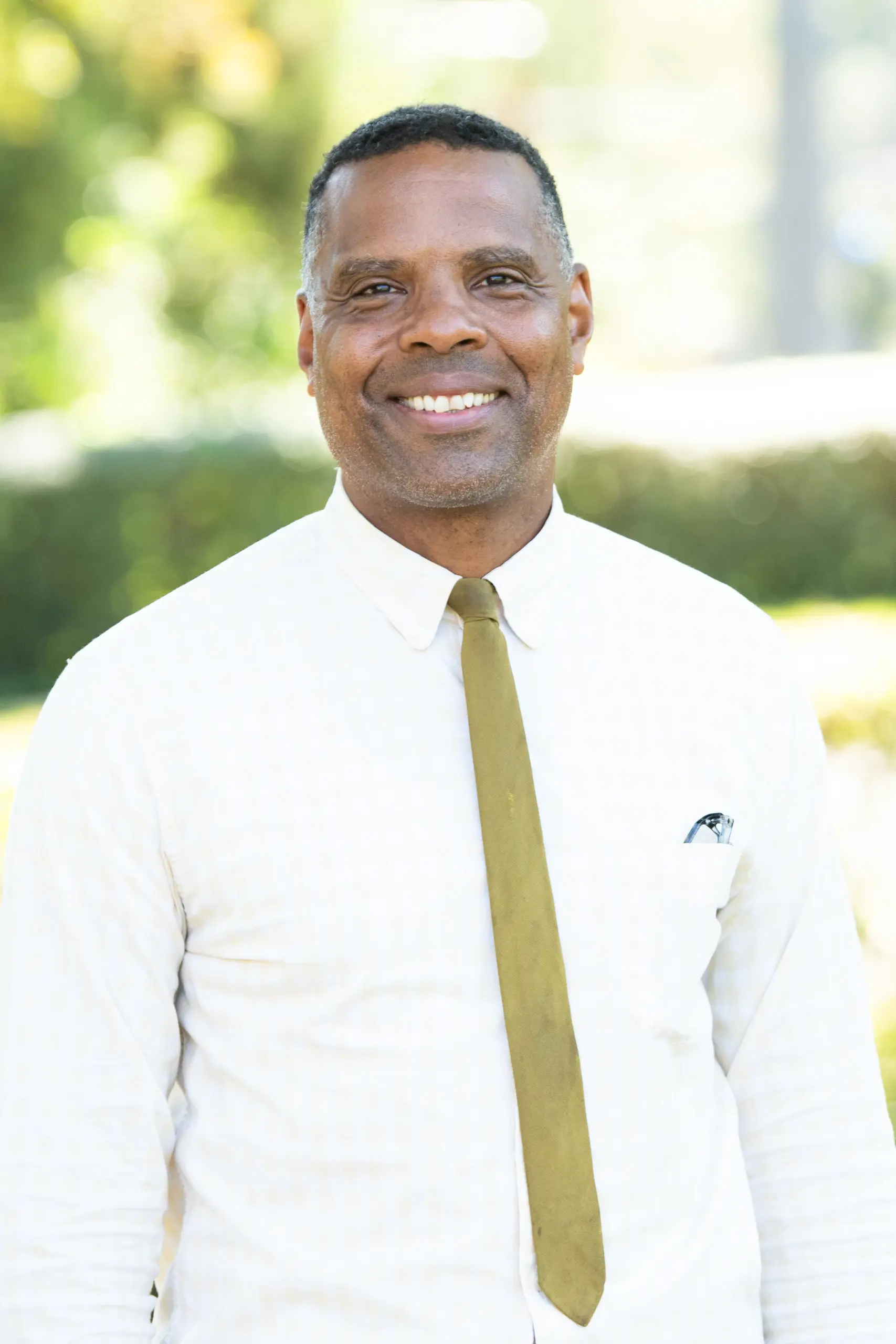
It was a playoff football game at Germantown Academy where a teenage Phillip Brown had what he calls “a God moment.”
Highly recruited as a Division I prospect, Brown stood on the field and felt something shift inside him. “In my spirit, I knew football was not my calling,” he recalls. “I knew I was going to do something different.”
That something different turned out to be theater—a path that would take Brown from the stages of Philadelphia to the studios of Hollywood, and eventually to Shipley, where he has spent nearly two decades shaping the next generation of actors and building one of the region’s most dynamic theater programs.
The Spark
Brown’s pivot from athletics to acting came through an unlikely source: a ninth-grader named Brian, whose uncle happened to be television star Jack Klugman of Quincy, M.E. fame. “I’ve seen your work in film and video class,” he told Brown. “I think you would be a great actor. You should join the Shakespeare Club.”
Brown laughs at the memory. “Everyone at GA thought it was a joke. They’d say, ‘Phil Brown is in the Shakespeare Club?’” But Brian became something of an unofficial agent, handing Brown an audition notice for a dinner theater production at LaSalle. He got the part, and after the show, a stranger approached him with prophetic words: “Whatever you have, just keep it. Don’t let all these acting programs steal your talent or take your honesty away. You should pursue this.”
The Journey
Brown pursued acting with passion. He earned a scholarship to the University of the Arts, where he studied under the legendary Walter Dallas, one of the first African American directors to head a BFA program. From there, his path wound through Hollywood, where he stayed in the guest house of University of the Arts friend Erica Alexander—then starring in Living Single—while cutting his teeth as a screenwriter and stand-in at Warner Brothers.
His career took him in multiple directions simultaneously. He founded Urban Artists, a nonprofit theater company dedicated to bringing performing arts to underserved communities. “I had never been exposed to theater, and then it changed my life,” Brown explains. “I wanted to expose underprivileged kids, in particular Black and brown kids in the inner city, to performing arts.” His motivational play, Beat Down the Negative, toured throughout the Philadelphia school system with the endorsement of then-superintendent Rotan Lee. The company performed in parks, on street corners, and at block parties— “guerrilla-style theater,” Brown calls it, “taking positive and motivational messages to people who would not normally step foot in a theater.”
Meanwhile, his professional career flourished. He created A.M. at BET, the network’s first cross-promotional live-to-tape TV show. Later, he joined Disney as a punch-up writer and acting coach, working on hits like That’s So Raven, Cory in the House, Suite Life of Zack and Cody, and Wizards of Waverly Place. He was working his way up through the Disney pipeline when tragedy struck: his brother passed away unexpectedly, leaving behind three small children.
“I immediately moved back to the East Coast,” Brown says. “I had three small kids—two nephews and a niece—who I had to anchor.”
A Calling to Shipley
What happened next reads like a scene from a screenplay. Brown received an unexpected phone call from Tony “Doc” Morinelli, Shipley’s longtime theater director, about interviewing for an open position. Brown hadn’t applied—his then-girlfriend (now wife), who was living in London at the time, had sent out his CV without telling him.
“I said, ‘Thank you, but I don’t think that’s for me,’” Brown recalls. But the calls kept coming. Seeking guidance, Brown looked for a sign while teaching a workshop in Pittsburgh. He had printed some acting scenes to use with students, including one called The Ketchup Bottle—written by Anthony Morinelli from The Shipley School. “I knew immediately—that was the sign.”
He interviewed with then-Head of School Steve Piltch, who made him an offer. “I know you’re mourning the loss of your brother,” Piltch told him. “This is a transitional moment for you. Just give it a year. I know you’re a Disney guy. By the way—we don’t have Disney money.” Brown laughs at the memory. “He gave me full autonomy to come in and make changes to what Shipley had established.”
Building an Inclusive Program
Brown’s vision was clear from the start: “Theater should not be a niche, elite club. It should touch everyone in the community, and everyone should feel they can explore the art form in a way that’s inclusive and equitable.”
When he arrived, all theater students—freshmen through seniors—were lumped into a single class. Brown restructured the program into three tiers: Theater 1 to introduce students to the craft; Theater 2 to deepen their understanding of character development, emotional connectivity, and physical work; Theater 3 to prepare serious students for BFA programs and conservatory auditions.
“My philosophy has always been to meet every kid where they are,” Brown explains. “The goal is not Hollywood or Broadway. The goal is for each kid to find their voice and work at the highest level they can.”
The results speak for themselves. Year after year, Shipley students have gained admission to top conservatories and BFA programs. Many are now working professionally as actors, directors, and producers. “They discovered their love, their passion here,” Brown says with pride. “To see that replicated gives me a deep sense of joy.”
Returning to His First Love
In recent years, Brown has returned to acting himself—a homecoming to what he calls his first love. The catalyst came from former colleague Emma Gibson, who challenged him to write down every accomplishment in his life and find the common thread. “The only throughline to every achievement in my life was acting,” Brown realized. “And that same voice I heard as a kid said, ‘Go back to your first love.’”
The results have been extraordinary. Brown won the Barrymore Award for Best Actor for his role in The Royale and was nominated again for American Moor. He recently starred in Dutchman and The Slave to critical acclaim, working with Shipley colleague and friend Ozzie Jones. Remarkably, he didn’t audition for any of these roles—theaters sought him out. This spring, he took on the role of Henry IV in Quintessence Theatre’s Rare Accidents, an abridgement of Shakespeare’s Henry IV Parts I & II at the Sedgwick Theater in Mt. Airy.
“I’ve made sacrifices over the years, and I wouldn’t change a thing,” Brown reflects. “Teaching has been the priority. But over the last couple of years, for my own soul, I needed to return to my first love.”
His students have noticed. “They look at me with a different level of respect,” Brown observes. “They give me more because they see me doing what I ask of them. I want them to know it’s possible.”
The Power of Theater
For Brown, theater is fundamentally about storytelling and celebrating the human condition. “I think it’s imperative that everyone see themselves reflected on stage,” he says. “They should see someone who looks like them, who comes from their world, who is struggling with the same issues they face.”
He believes exposure is everything. “You don’t know you can tell that story unless you see a story told. You don’t know what food you like until you taste it. And once you taste it, you think, ‘That’s my thing.’”
The trust Brown builds with his students enables remarkable breakthroughs. “When you have that trust, it’s amazing what people discover about themselves. They feel uninhibited—they can fall and it’s okay to fall.”
“You never know who’s sitting in front of you in a classroom,” Brown reflects. “Everyone has the potential to be the best at what they’re called to do. And you have them for that season to make an impact, to plant that seed.”
A Historic Tenure
Brown notes with quiet pride that he has become the longest-tenured African-American full-time faculty member in Shipley’s history—a distinction he never set out to achieve. “I remember talking to Steve Piltch when I got here. He said, ‘Just give me six years.’ And I laughed at him. I said, I’m not going to be here for six months.”
Nearly two decades later, he reflects on the irony of his journey. “I thought, I’ve left Hollywood, I’ve lost my brother—that chapter is closed. But I’m going to teach what I love as best I can. Who would have thought that by leaving Hollywood, I’d end up influencing so many young people who are now working there? That’s pretty wild.”
For Brown, teaching and acting are not separate pursuits but complementary ones. “Teaching has made me a better actor and acting has made me a better teacher,” he says. “Whatever we’re called to do, we’re also called to teach it and give it back.”